DSAC Enterprise AI Command Center™
Enterprise AI That Works Inside Your Security Boundary
This is not simply an LLM brought behind the firewall. It is a secure, integrated architecture of specialized AI capabilities, protected company knowledge, governed access, controlled tools, and accountable human decision-making.
- Private, dedicated, or hybrid deployment
- Multi-model and model-agnostic architecture
- Human approval for consequential actions
Every request passes through the control plane.
The enterprise problem
A Private Model Alone Does Not Create a Secure AI Program
Moving an LLM inside the firewall may reduce one form of exposure, but it does not determine who can access sensitive information, which tools the AI may use, whether information may leave the organization, or which actions require human approval.
Disconnected Intelligence
Employees use separate public tools, isolated data sources, and inconsistent workflows without a unified governance or security layer.
Invisible Data Movement
Leadership may not know what confidential information is being uploaded, retained, processed, trained on, or shared externally.
Uncontrolled Agent Actions
AI connected to email, files, databases, or business systems can create significant exposure when permissions, boundaries, and approvals are not designed first.
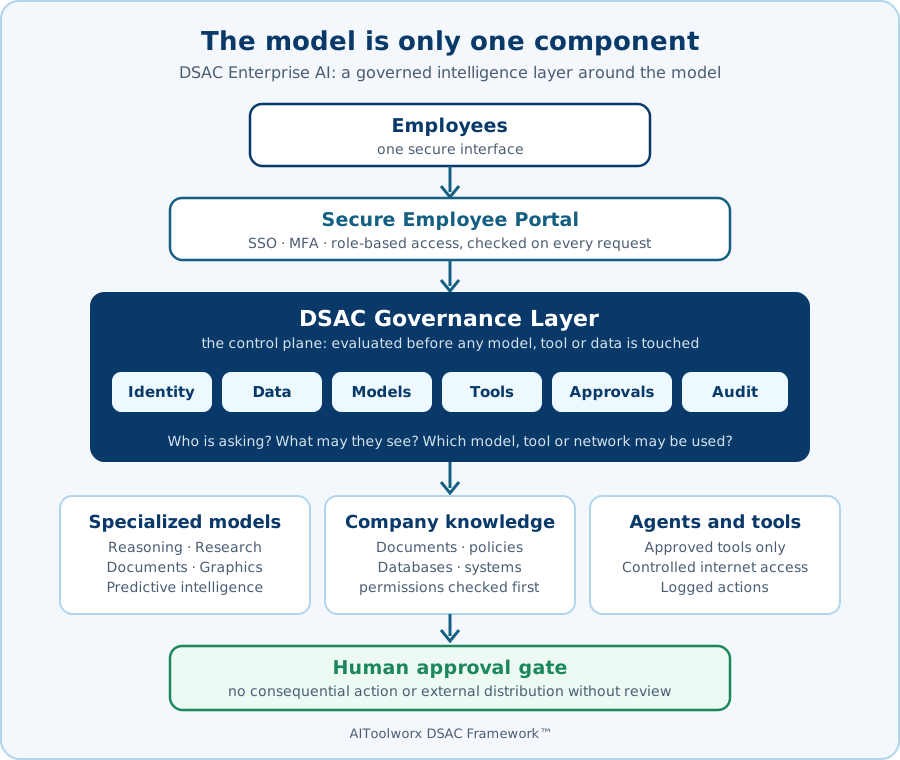
An integrated architecture
The Model Is Only One Component
A locally hosted model is still only a model. By itself, it does not understand which employees should access which information, whether confidential data may be used in a particular workflow, which external sources are approved, or when an action requires human review.
The DSAC Enterprise AI architecture creates a governed intelligence layer across the organization. Employees work through one secure interface, while a coordinated environment of models, agents, data sources, permissions, policies, and controls operates behind it.
The architecture is model-agnostic. Models may be selected, evaluated, replaced, or routed according to the task, sensitivity of the information, performance, cost, and organizational risk.
Private LLM vs. Enterprise AI architecture
Private LLM
- One model
- Limited company context
- No policy orchestration
- No integrated approvals
- No enterprise-wide audit structure
DSAC Enterprise AI
- Multiple specialized models and agents
- Governed access to company knowledge
- Identity and data-aware routing
- Controlled tools and internet access
- Human approval and complete audit visibility
A coordinated AI team
Specialized Intelligence for Enterprise Work
One model should not be expected to perform every task. The DSAC architecture routes work to the appropriate capability while applying consistent security, identity, data, and approval policies.
Reasoning and Strategy
Complex analysis, policy interpretation, strategic planning, risk assessment, scenario development, and executive decision support.
Analyze · Compare · Recommend
Research and Intelligence
Controlled research across approved internal repositories, public sources, regulatory materials, vendor documentation, market information, and industry databases.
Find · Verify · Cite
Documents and Communication
Reports, policies, proposals, presentations, spreadsheets, meeting briefs, contract comparisons, and training materials using approved company templates.
Draft · Format · Standardize
Graphics and Media
Process diagrams, infographics, data visualizations, training graphics, presentation visuals, product concepts, and approved media workflows.
Visualize · Explain · Communicate
Predictive Intelligence
Forecasting, trend analysis, operational risk indicators, scenario modeling, demand projections, financial outlooks, and decision-support models.
Forecast · Model · Prepare
Coordinated intelligence
Agents Collaborate. The Organization Remains in Control.
Example request: “Evaluate the operational and security risks of acquiring Company X.”
- 01
Research Agent
Collects verified public and approved internal information.
- 02
Document Agent
Reviews financial, legal, operational, and technical materials.
- 03
Predictive Agent
Models growth, integration, risk, and downside scenarios.
- 04
DSAC Risk Agent
Evaluates data, identity, SaaS, AI, vendor, and security exposure.
- 05
Reasoning Agent
Synthesizes the findings and identifies assumptions and uncertainty.
- 06
Graphics and Document Agents
Prepare the executive brief and presentation.
The control plane
Governance Before Generation
Before an agent retrieves information, uses a model, accesses the internet, or takes an action, the DSAC governance layer evaluates the operating context.
- 01
Who is making the request?
- 02
What is that person authorized to access?
- 03
What classification applies to the data?
- 04
Which models may process the information?
- 05
Can the request access the internet?
- 06
Which tools and systems may the agent use?
- 07
Does the action require human approval?
- 08
What must be logged, retained, or deleted?
The goal is not uncontrolled autonomy. The goal is governed augmentation.
Secure knowledge access
AI Access Should Never Override Existing Permissions
Company documents, policies, databases, operational systems, and institutional knowledge can be made available to approved agents without creating one unrestricted pool of information. Access controls must be checked before information enters the model context — not after a response has already been generated.
- Executive and Boardpermission gate
- Financepermission gate
- Legal and Compliancepermission gate
- Human Resourcespermission gate
- Operationspermission gate
- Sales and Marketingpermission gate
- Client or Portfolio Companypermission gate
- Project or Deal Teampermission gate
Deployed around the organization
Private, Dedicated, or Hybrid
On-Premises AI Enclave
Maximum organizational control
Models, company knowledge, retrieval systems, and approved agents operate inside the client's physical or virtual infrastructure.
- Sensitive intellectual property
- Legal and regulated information
- Confidential transactions
- Restricted operational environments
Dedicated Private Environment
Private infrastructure without operating it alone
The client receives isolated, dedicated infrastructure in a professionally managed data center or private environment.
- Limited internal infrastructure staff
- Managed availability and maintenance
- Dedicated processing and storage
- Defined service-level requirements
Governed Hybrid Architecture
Private data with selective external capability
Sensitive retrieval and reasoning remain private. Approved external models or services may be used for public research, advanced graphics, or specialized processing when policy allows.
- Broader model capabilities
- Controlled public research
- Peak-demand capacity
- Cost and performance optimization
Built on the DSAC Framework™
Enterprise AI Must Be Designed Around the Organization
- 01
People
Who uses AI, who approves actions, who receives training, and where shadow AI already exists.
- 02
Processes
Approved use cases, human review, data handling, incident response, change management, and retention.
- 03
Hardware
Private compute, encrypted storage, segmentation, endpoint controls, resilience, and physical security.
- 04
Platforms
Models, agents, identity systems, retrieval platforms, business applications, monitoring, and controlled internet access.
- 05
Data
Classification, ownership, permissions, lineage, encryption, retention, deletion, and restrictions against unauthorized training.
The DSAC Framework evaluates not only what technology is deployed, but how people, processes, hardware, platforms, and data interact throughout the AI environment.
From discovery to deployment
Build the Architecture Around Real Enterprise Needs
- 01
DSAC AI Discovery
Identify existing AI usage, shadow AI, sensitive-data exposure, business requirements, current systems, and high-value use cases.
- 02
Architecture and Governance
Define the deployment model, identity structure, data boundaries, approved models, agent permissions, internet access, and human approval requirements.
- 03
Controlled Pilot
Launch a focused pilot around a limited number of valuable workflows before expanding access or granting consequential agent capabilities.
- 04
Managed AI Assurance
Evaluate performance, monitor security, review permissions, test model changes, track new risks, and continually align the environment with business needs.
AIToolworx leads discovery, governance, business alignment, risk management, and continuing assurance. Qualified technical partners manage hardware, model infrastructure, data integration, identity systems, monitoring, patching, and operational support.
Do Not Start With the Model. Start With the Organization.
A secure enterprise AI program begins by understanding where information lives, how employees already use AI, which workflows create value, and where uncontrolled systems may be creating exposure.
AIToolworx — AI and Data Security Integration for Real-World Solutions